Healthcare & hospitals
The evidence a hospital turnover actually runs on.
Healthcare work is commissioning-heavy and evidence-heavy: infection-control barriers, medical gas, above-ceiling before the hard lid closes. RTI holds the documented, dated record each system is verified against, so the commissioning authority and the inspector are reviewing proof, not chasing it.
A real inspection point
What this looks like on your job
One tag, one checklist, and the photos that have to come with it.
Tag
Level 3 OR-2, Above-Ceiling Sign-Off
HC-L3-OR2-AC
- Sticker location
- Corridor access panel outside OR-2
- Bound checklist
- Above-ceiling documentation, pre hard-lid
- Medical gas piping labeled and staged for third-party verification2 photos required
- Firestopping complete at rated penetrations3 photos required
- Duct and terminal units supported and sealed2 photos required
- Infection-control barrier intact at work zone1 photo required
Checklists for your work
Start from a checklist that already knows the walk
Real guides from the RTI library. Sections in build order, what to look for on each item, and the photos that prove it. Free to read, one click to run on a tag.
- ITPInspection and test plan (ITP)Activities, acceptance criteria, hold points and the record per row.11 items8 photos
- FirestoppingFirestopping inspection checklistRated assemblies, penetrations, joints and listed system compliance.13 items27 photos
- HVAC FinalHVAC final inspection checklistGrilles, registers, balancing and controls verified before startup and turnover7 items9 photos
What gets in the way, and what RTI does about it
Today
Above-ceiling gets closed before someone photographs medical gas and firestopping, and now the hard lid has to come back down to prove it.
With RTI
The photo requirement is enforced before the above-ceiling item can be submitted, so the shot above the grid is taken while the grid is open. The documented record is complete before the hard lid closes.
Today
Commissioning and the inspector arrive and turnover becomes a scavenger hunt across binders, drives and inboxes for the evidence each system was verified against.
With RTI
Every checklist answer and photo lives on the system's tag, and the commissioning authority and inspector sign off onto the same tamper-evident record from a scoped portal login. They review the documented evidence in place instead of chasing it.
Today
Months after occupancy a regulated system is questioned and nobody can show when the barrier was checked or who verified the gas.
With RTI
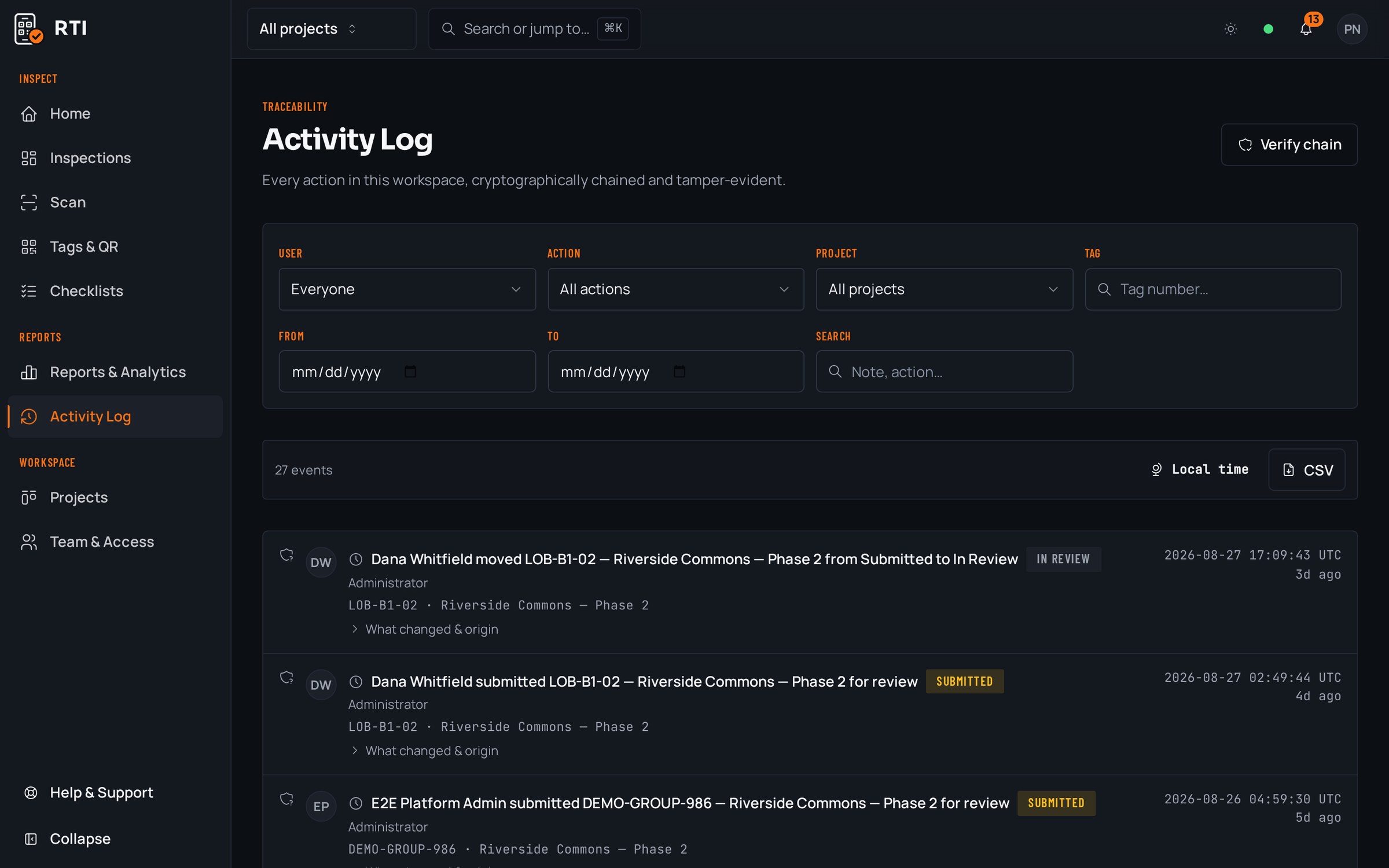
Every action is written to an activity log hashed over the previous entry with SHA-256. The verifier's sign-off, the dates and the photos are fixed on the record, and any later alteration breaks every hash after it.
Questions healthcare & hospitals ask
- Above-ceiling work has to be documented before the hard lid closes. How does RTI enforce that?
- The photo gate. An above-ceiling submission can't leave the phone until every required photo is attached, so ductwork, medical gas, firestopping and hangers are captured on the tag while the ceiling is open. Once the hard lid is on, the documented record is already sitting on that inspection point.
- Who verifies regulated systems like medical gas? Is RTI certifying anything?
- No. RTI does not certify or approve anything. It holds the documented record and routes it for review. The commissioning authority, the verifier and the authority having jurisdiction sign off on the same tamper-evident record, so their verification and your evidence live in one place.
- Infection-control barriers get checked constantly during a hospital fit-out. Can we log those against a specific area?
- Yes. Place a tag on the containment barrier or the work zone and bind an infection-control checklist to it. Each check is answered and photographed against that exact location and dated on the activity log, so the interim record is documented as the work proceeds rather than reconstructed later.
Put it on a real job.
Tag one area, run one walk, and see the record it leaves behind. Start free. 30 days, no card required.