For project engineers
Evidence captured as it's built, not chased after.
You run the submittals, the RFIs and the ITPs, and most of your week goes to chasing the photo or the signature that proves an approved detail actually got built. RTI captures that proof at the point of work, tagged to the location, so the record is already assembled when it's time to close the item.
A real inspection point
What this looks like on your job
One tag, one checklist, and the photos that have to come with it.
Tag
Grid C4-C6, Slab Pre-Pour Hold Point
PDK-L2-CP-C4
- Sticker location
- Formwork edge at column line C4
- Bound checklist
- Slab pre-pour, ITP hold point
- Rebar size and spacing verified against approved shop drawings3 photos required
- Embeds and sleeves located per the coordination set2 photos required
- Formwork dimensions and elevations checked2 photos required
- Third-party inspection witnessed and released1 photo required
Checklists for your work
Start from a checklist that already knows the walk
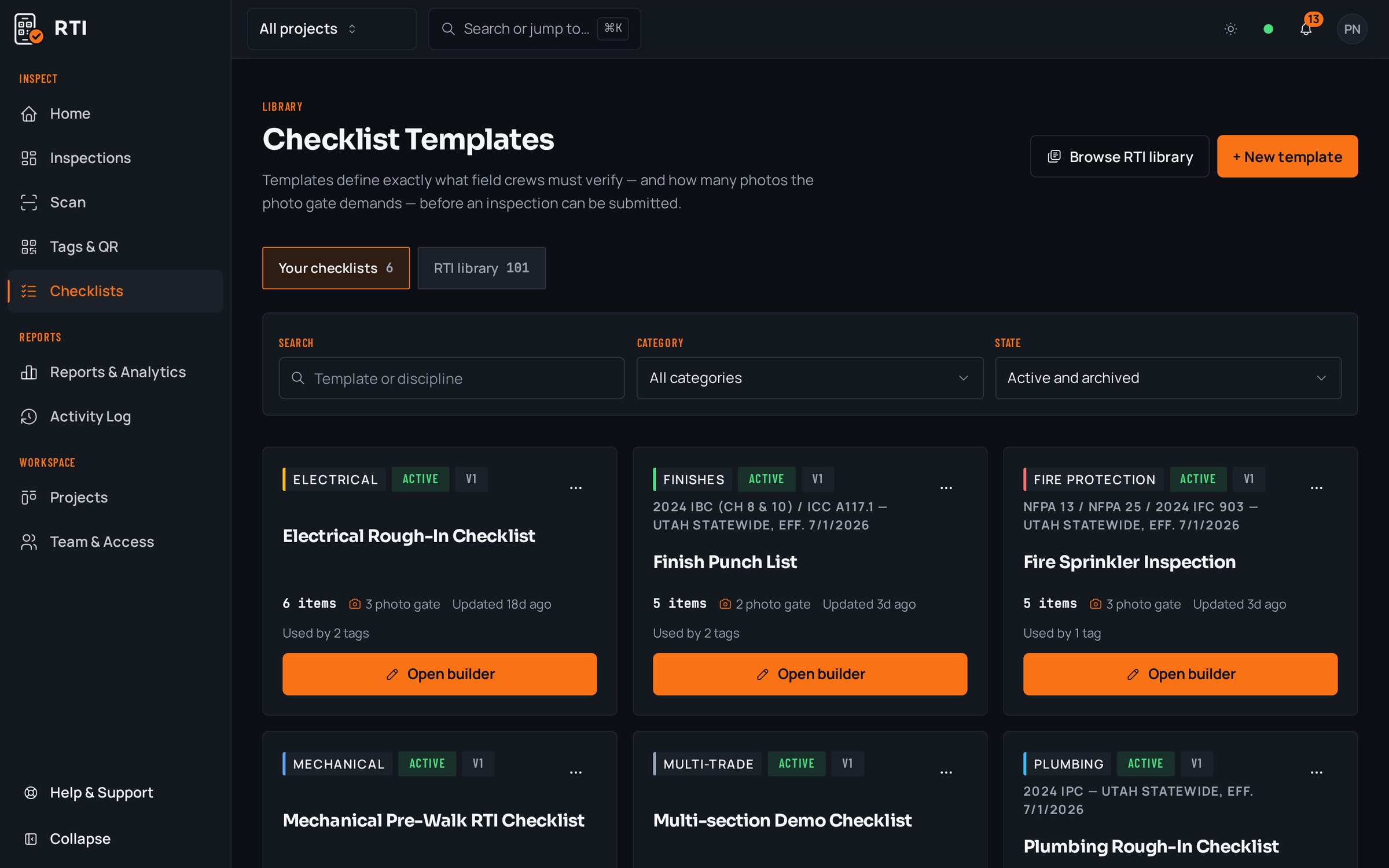
Real guides from the RTI library. Sections in build order, what to look for on each item, and the photos that prove it. Free to read, one click to run on a tag.
- ITPInspection and test plan (ITP)Activities, acceptance criteria, hold points and the record per row.11 items8 photos
- Pre-pourPre-pour concrete checklistSubgrade, formwork, rebar, embeds and cover before the truck arrives.13 items23 photos
- Structural steelStructural steel inspection checklistAnchorage, erection tolerance, bolting, welding and coatings.12 items27 photos
What gets in the way, and what RTI does about it
Today
You can't close the submittal because the one photo that proves the detail was installed is on someone's phone, or was never taken, and the crew has moved to another floor.
With RTI
The photo is captured against the checklist item at the moment of work and stored on the tag. By the time you go to close the item, the evidence is already filed, timestamped and attributed, not something you have to reconstruct.
Today
A hold point gets skipped, the pour or the cover goes ahead, and now you're writing an RFI to document work no one inspected before it was buried.
With RTI
The hold-point checklist must be submitted with its photos before the tag can be marked complete, and it sits on the review board for release. The inspection is on the record before the concrete is, not reconstructed afterward.
Today
Reconciling installed work to the approved submittal means cross-referencing a folder of undated photos against a stack of drawings, hoping they line up.
With RTI
Each verification photo lives on the checklist item and the location tag that produced it. The installed condition and the item it answers stay together, so the reconciliation is a record you read, not a puzzle you assemble.
Questions project engineers ask
- How does RTI help me close out submittals and ITP line items?
- The proof for each item is captured against the checklist item it supports and stored on the tag, with a timestamp and the person who took it. When you go to close the submittal or the ITP line, the photos and answers are already there and attributable, so you stop emailing the field for a shot that should exist.
- Can I enforce a hold point so work doesn't proceed without the inspection?
- Yes. Build the hold-point checklist, bind it to the tag on the physical location, and the required photos and answers must be submitted before it can be marked complete. It lands on the review board for you to accept or reject, so the record of the hold point exists before anyone covers or pours over it.
- How do I match what was installed to the approved submittal?
- The checklist item asks the crew to verify the installation against the approved shop drawing and photograph it. The photo, the answer and the location tag stay together, so reconciling installed work to the approved set is reading one record instead of cross-referencing a camera roll against a document.
Put it on a real job.
Tag one area, run one walk, and see the record it leaves behind. Start free. 30 days, no card required.